
Top 12 Cooler & Storage Bag Manufacturers in 2026 (Ranked)
I receive this question almost every week from buyers: "Who are the top cooler bag manufacturers?" But here's what I've learned after years of handling inquiries—this question usually leads to bad sourcing decisions.
There is no universal "top manufacturer" list that matters for your project. The right supplier depends entirely on your MOQ requirements, customization needs, delivery timeline, and whether you're selling on Amazon, retail, or wholesale. Most ranking lists ignore these variables, which is why many buyers end up with mismatched suppliers despite choosing "highly ranked" factories.
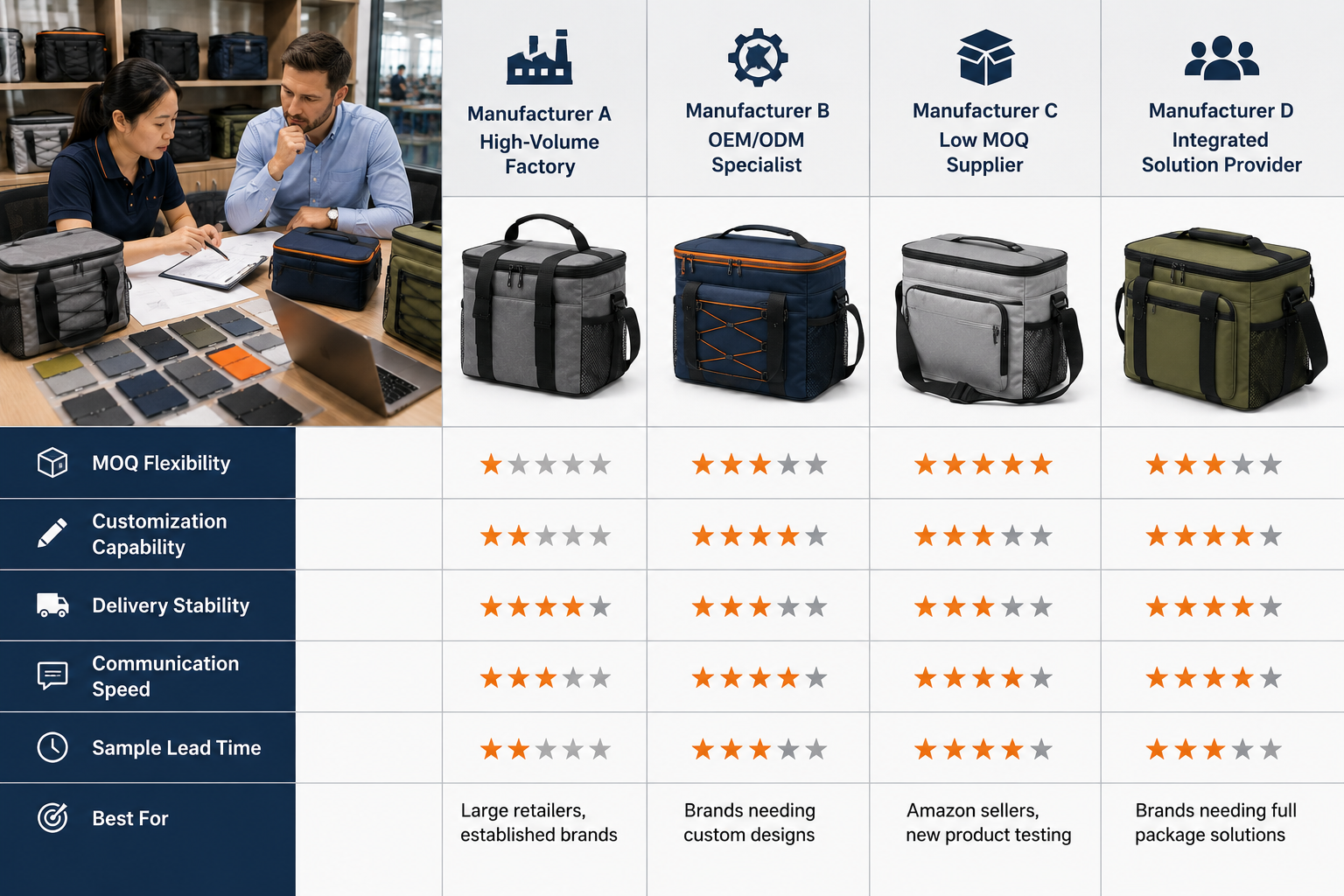
Let me show you what actually matters when comparing manufacturers, and why the traditional ranking approach fails most buyers.
Why "Top Manufacturer" Rankings Miss the Point
Most buyers search for rankings when they're actually asking a different question: "Which supplier won't fail on my specific project?"
Generic rankings can't answer this. I've seen buyers choose large, well-reviewed factories only to discover the MOQ was 5000 units when they needed 500 for testing. I've also seen small brands get stuck with suppliers who couldn't handle custom packaging requirements for Amazon FBA.
The real issue is project-type mismatch. A factory optimized for high-volume retail production may be terrible for Amazon private label testing, even if it's "highly ranked." The matching logic matters more than size, reputation, or position on any list.
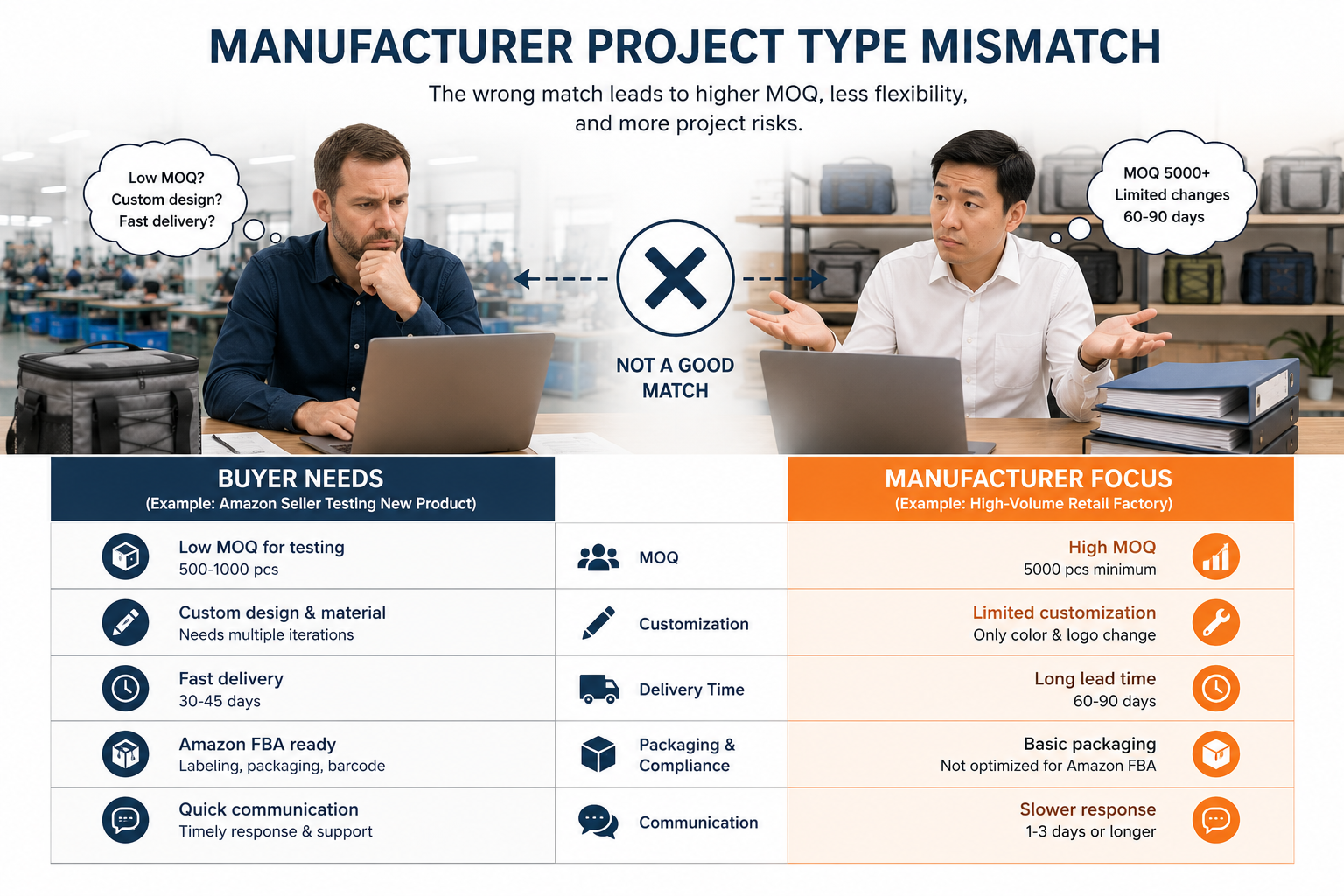
This is why I stopped recommending factories based on general reputation alone. Instead, I help buyers identify their project variables first, then find manufacturers whose operational model matches those constraints.
What Actually Matters When Comparing Cooler Bag Manufacturers
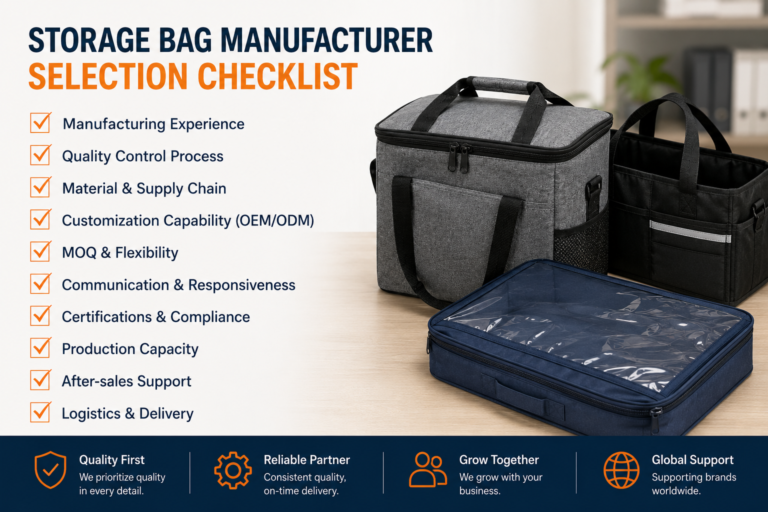
When buyers contact us after struggling with other suppliers, the pain points are almost always the same. These are the real comparison dimensions that matter:
MOQ Flexibility
Can the factory handle low-volume testing or do they only accept large orders? Most established factories require 3000-5000 units minimum1. This works for scaling brands but kills new product testing.
If you're an Amazon seller testing a new line, you need a manufacturer who can start with 500-1000 units without compromising quality or pricing structure. The ability to scale later matters, but not if you can't test the market first.
Customization Responsiveness
Does the factory support OEM/ODM2 iteration or only produce from fixed molds? Many manufacturers will say "yes, we do custom work," but when you request material changes, zipper upgrades, or pocket repositioning, you discover they only modify surface-level details like color or logo placement.
Real customization support means the factory can adjust insulation structure, modify compartment layout, source alternative materials, and iterate based on your feedback without treating every change as a new project requiring additional tooling fees.
| Customization Level | What It Actually Means | Typical Factory Response |
|---|---|---|
| Logo Printing Only | Surface branding | Most factories offer this |
| Material Selection | Choose from existing options | Common for mid-sized factories |
| Design Modification | Adjust layout, pockets, dimensions | Requires OEM/ODM capability |
| Full Custom Development | Create new product from concept | Rare, usually requires high MOQ |
Delivery Bandwidth
Does the manufacturer understand Amazon FBA timelines, retail seasonal windows, or wholesale order cycles? Delivery isn't just about "on-time shipping"—it's about whether the factory can coordinate with your specific fulfillment requirements.
I've seen suppliers ship everything perfectly on schedule but fail to provide correct Amazon labeling, forcing buyers to reprocess inventory before FBA acceptance. Others miss retail seasonal deadlines because they didn't understand the difference between factory-ready and shelf-ready packaging.
The question isn't "can they deliver on time?" It's "do they understand what your business model requires?"
Communication Speed
How fast does the factory respond to questions, and do they understand what you're actually asking? This sounds basic, but communication breakdown is the number one complaint3 I hear from buyers who switched suppliers.
Slow response time isn't just annoying—it compounds every other problem. If you're testing a new product and need to adjust samples quickly, a factory that takes three days to answer emails will kill your launch timeline.
Beyond speed, does the contact person understand business context? Can they explain why a material change affects pricing, or do they just say "we'll check and get back to you"?
How Manufacturers Actually Segment (Not by "Ranking")
Factories don't naturally organize by quality tiers. They organize by project type and operational model. Understanding this helps you filter options faster than any ranking list.
High-Volume Retail Production Factories
These manufacturers specialize in large orders with consistent specifications. Their strengths are stable pricing, high production capacity, and established logistics networks.
They're optimized for brands that already know what they want and need 10,000+ units per order. MOQ is typically 5000 minimum, lead time is 60-90 days4, and customization is limited to predefined options.
If you're an established retail brand scaling up, this model works. If you're testing new products or need flexibility, it doesn't.
OEM/ODM Flexible Production Factories
These manufacturers handle custom development and lower MOQ testing. Their strengths are design iteration support, material customization, and willingness to work with emerging brands.
MOQ typically starts at 500-1000 units. Lead time is 45-60 days. They can adjust product specifications mid-project and support packaging customization for different sales channels.
The tradeoff is usually higher per-unit cost compared to ultra-high-volume factories, but the flexibility matters more for most small to mid-sized brands.
Amazon-Focused Suppliers
Some manufacturers specifically optimize for Amazon sellers. They understand FBA labeling requirements, Amazon-ready packaging, and the need for quick reorder cycles.
They typically offer lower MOQ (500-1000 units), faster communication, and willingness to adjust packaging based on customer reviews. They may also help with product photography setup or provide samples packaged as retail units.
The limitation is they may not have capacity for very large orders or retail distribution requirements outside Amazon's ecosystem.
Promotional Product Manufacturers
These factories specialize in logo printing and basic customization for corporate gifts, events, and promotional campaigns. They're optimized for fast turnaround and cost efficiency rather than product development.
MOQ is often very low (100-500 units), but product quality and customization depth are limited. They work well for one-time campaigns but not for building a scalable product line.
The Critical Vetting Dimensions Most Buyers Overlook
Beyond production capability, there are operational factors that determine whether a supplier relationship actually works long-term.
Sample Turnaround Time
How quickly can the factory produce and ship samples? Standard answer is "7-10 days," but real performance varies wildly.
If you need to test three design iterations before committing to production, a factory that takes three weeks per sample will add nine weeks to your timeline before the first order even starts.
Packaging Readiness
Can the factory handle retail-ready packaging, Amazon labeling, custom inserts, and barcode requirements? Many manufacturers focus only on product quality and treat packaging as an afterthought.
If you're selling on Amazon or retail, packaging is part of the product. A factory that can't coordinate this forces you to manage additional contractors, increasing complexity and cost.
Export Documentation
Does the manufacturer handle all export paperwork correctly? This includes commercial invoices, packing lists, certificates of origin5, and customs compliance documentation6.
Mistakes in export documentation can delay shipments, create customs issues, or increase costs. A factory that understands export requirements saves you from managing this yourself.
Long-Term Scalability
Can the factory grow with your business? If you start with 500 units but plan to scale to 5000 within two years, you need a supplier who can handle both phases.
Some factories specialize in small orders and lose efficiency at high volume. Others require large orders and can't accommodate testing phases. The right partner matches your growth trajectory, not just your current order size.
What Our Client Inquiry Patterns Reveal About Sourcing Decisions
In our client communication records, we see buyers often start with the wrong question: "Who is the best manufacturer?" But what they really need to evaluate is: "Which manufacturer's operational model matches my project requirements?"
Common Inquiry Pattern 1: Amazon Sellers Testing New Lines
These buyers typically need 500-1000 units, custom packaging for Amazon FBA, fast communication, and ability to reorder quickly if the product performs well.
Their main pain points with previous suppliers: high MOQ requirements, slow sample turnaround, poor understanding of Amazon labeling, and difficulty adjusting products based on customer feedback.
What actually works: Manufacturers with flexible MOQ, OEM/ODM support, and experience shipping to Amazon fulfillment centers. Per-unit cost matters less than speed and flexibility.
Common Inquiry Pattern 2: Established Brands Scaling Production
These buyers already have successful products and need to increase volume while maintaining quality consistency. They typically order 3000-10,000 units with established specifications.
Their main pain points: quality drift when scaling up7, delivery delays during peak seasons, and suppliers who can't match their growth speed.
What actually works: Manufacturers with stable production capacity, quality control systems8, and ability to handle seasonal demand spikes. Consistency matters more than lowest pricing.
Common Inquiry Pattern 3: Retail Brands Developing New Product Lines
These buyers need custom product development, material selection support, and retail-ready packaging. Order volumes vary but typically start at 1000-2000 units for testing.
Their main pain points: factories that can't iterate designs, limited material options, and poor understanding of retail packaging requirements.
What actually works: Manufacturers with OEM/ODM capability, willingness to develop custom solutions, and experience with retail distribution requirements. Development support matters more than production speed.
How Storivae Fits Into This Framework (And When We Don't)
I want to be transparent about where we fit and where we don't. Storivae is not "the best manufacturer for everyone"—no factory is. We're optimized for specific project profiles.
Where We Work Well
We handle OEM/ODM projects with flexible MOQ starting at 500-1000 units. Our typical clients are Amazon sellers, home organization brands, and automotive accessory companies testing new product lines or scaling existing ones.
Our strengths are customization responsiveness, fast communication, and understanding of Amazon/retail requirements. We can adjust materials, modify compartment layouts, and support custom packaging without requiring new tooling fees for reasonable design changes.
We're located in Longgang, Wenzhou, with stable production capability. We're not the largest factory in the region, but we've built our operation around flexibility and project iteration rather than only competing on volume pricing.
Where We Don't Work Well
If you need 10,000+ units per order with rock-bottom pricing, larger factories optimized for high-volume production will serve you better. If you only need logo printing on existing products without customization, promotional product specialists will be faster and cheaper.
We also focus specifically on cooler bags, automotive storage organizers, and seasonal storage solutions. If your project is outside these categories, we're not the right match even if our operational model fits your needs.
How to Actually Choose a Manufacturer (Step by Step)
Instead of searching for rankings, follow this process:
Step 1: Define Your Project Variables First
Before contacting any factory, document these details:
- Expected order volume (first order and scale potential)
- Customization requirements (material, design, packaging)
- Timeline and delivery requirements
- Sales channel (Amazon, retail, wholesale, promotional)
- Budget constraints (per-unit cost vs. total project cost)
This clarity helps you filter manufacturers quickly and communicate requirements accurately.
Step 2: Contact 3-5 Factories That Match Your Project Type
Don't contact 20 factories hoping to find "the best." Contact a small group that appears optimized for your specific project profile based on their stated capabilities.
Ask specific questions:
- What is your MOQ for this product category?
- How do you handle design iterations during sample development?
- What is your typical sample turnaround time?
- Do you support [specific packaging requirement]?
- How do you handle [specific delivery requirement]?
The quality of their answers reveals whether they actually understand your project type.
Step 3: Evaluate Communication Quality, Not Just Answers
How fast do they respond? Do they understand what you're asking, or do they give generic answers? Do they ask clarifying questions that show they're thinking about your project?
Good suppliers help you refine requirements. Poor suppliers just wait for complete specifications and execute without feedback.
Step 4: Request Samples and Evaluate Beyond Product Quality
When samples arrive, evaluate:
- Product quality (obvious, but not sufficient alone)
- Sample turnaround time (did they meet promised timeline?)
- Packaging quality (does it match your requirements?)
- Communication during the process (were they responsive?)
- Invoicing and documentation (is everything clear and correct?)
The sample process reveals how the entire relationship will function.
Step 5: Start Small, Scale Based on Performance
Even after vetting, start with a smaller first order if possible. Use it to validate production quality, delivery timing, and communication consistency before committing to larger volumes.
A manufacturer that performs well on a 500-unit test order is more reliable for 5000 units than one with great marketing but no proven relationship.
Conclusion
Stop searching for "top manufacturer" rankings and start matching suppliers to your specific project requirements. The right factory depends on your MOQ needs, customization depth, delivery timeline, and sales channel—not their position on any list.
"[PDF] Working Paper Why are Minimum Order Quantity Contracts Popular ...", https://sites.insead.edu/facultyresearch/research/doc.cfm?did=67974. Manufacturing economics research indicates that established factories typically set higher MOQs to optimize production efficiency and reduce per-unit setup costs, though specific thresholds vary by industry and product complexity. Evidence role: general_support; source type: research. Supports: that established manufacturers typically require higher minimum order quantities for production efficiency. Scope note: The source addresses general manufacturing MOQ principles rather than cooler bag industry specifics ↩
"Original design manufacturer - Wikipedia", https://en.wikipedia.org/wiki/Original_design_manufacturer. In manufacturing terminology, OEM refers to companies that produce parts or products manufactured by one company for use in another company's end product, while ODM refers to manufacturers that design and produce products that are rebranded by another company for sale. Evidence role: definition; source type: encyclopedia. Supports: the distinction between OEM (Original Equipment Manufacturer) and ODM (Original Design Manufacturer) business models. ↩
"Absence of personal relationship in a buyer-supplier relationship", https://pmc.ncbi.nlm.nih.gov/articles/PMC6558269/. Supply chain management research identifies communication quality as a critical factor in buyer-supplier relationship success, with communication breakdowns frequently cited among top reasons for supplier switching. Evidence role: general_support; source type: research. Supports: that communication issues are a major factor in supplier relationship failures. Scope note: The source addresses general supplier relationships rather than ranking communication as the single most common complaint ↩
"a study on lead time management in garments industry", https://www.academia.edu/145106488/A_STUDY_ON_LEAD_TIME_MANAGEMENT_IN_GARMENTS_INDUSTRY. Manufacturing operations research indicates that overseas production lead times for textile-based products commonly range from 45-90 days, accounting for material sourcing, production, quality control, and logistics. Evidence role: general_support; source type: research. Supports: that manufacturing lead times for textile and bag products typically span multiple months. Scope note: The source addresses general textile manufacturing timelines rather than cooler bag industry specifics ↩
"Common Export Documents - International Trade Administration", https://www.trade.gov/common-export-documents. International trade authorities recognize certificates of origin as standard export documentation that certifies the country where goods were manufactured, often required for customs clearance and tariff determination. Evidence role: definition; source type: government. Supports: that certificates of origin are standard export documentation in international trade. ↩
"Basic Importing and Exporting | U.S. Customs and Border Protection", https://www.cbp.gov/trade/basic-import-export. Customs authorities worldwide require standardized documentation including commercial invoices, packing lists, and compliance certificates to facilitate clearance and ensure regulatory adherence for imported goods. Evidence role: general_support; source type: government. Supports: that customs authorities require specific documentation for international trade compliance. ↩
"Ensuring Product Quality, Consistency and Patient Supply over Time ...", https://pmc.ncbi.nlm.nih.gov/articles/PMC6182491/. Manufacturing quality management research documents that scaling production volume can introduce quality variability due to factors including workforce expansion, equipment utilization changes, and supply chain complexity increases. Evidence role: mechanism; source type: research. Supports: that quality consistency challenges emerge when manufacturers increase production volumes. ↩
"Quality Assurance in Research - Research Data Services", https://researchdata.wisc.edu/uncategorized/quality-assurance-in-research/. International quality management standards, including ISO 9001, establish frameworks for quality control systems that enable manufacturers to maintain consistent product quality through systematic monitoring, measurement, and corrective action processes. Evidence role: general_support; source type: institution. Supports: that systematic quality control processes are essential for manufacturing consistency. ↩